
Falling Down (1993) and The Commuter (2018): Two movies separated by twenty-five years, roughly one generation, present noticeably different attitudes to roughly the same concepts and societal conditions.
How those “societal conditions” are portrayed are startingly different as well.
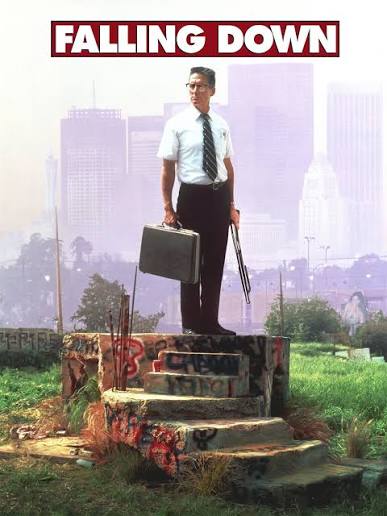
The two main characters represent a similar type: White male working man with a family. The state of the relationships could not be more different, however. The difference in ages may or may not be significant.
One man is trying to save his family from an outside threat. The other poses a threat, although he clearly believes he is doing something to save them and himself.
The action in both takes place, more or less, on a single day. The focus on commuting is inverted in each film. The two are a kind of Yin-Yang of each other.
To clarify, Bill Foster, aka D-FENS, in Falling Down (Michael Douglas) decides to divert from his work schedule and “go home” for his daughter’s birthday. In The Commuter, Michael MacCauley (Liam Neeson) is trying to carry on with his usual routine even as events veer off into improbable situations only plausible in a certain kind of film.
This kind of ridiculous turn of events should be very familiar to movie-goers. Hitchcock is probably best known for it. North by Northwest and Strangers on a Train for example.
Both of those Hitchcock films also owe something to the Secret Life of Walter Mitty Syndrome. Middle class (dare we say bourgeois?) values and norms seem constantly to give rise to juvenile fantasies for the working man.
Predictability and lack of daring-do risks make every Man Jack a dull boy who as such as a boy’s fantasies of being a classic masculine hero with a heavy focus on violence and aggression.
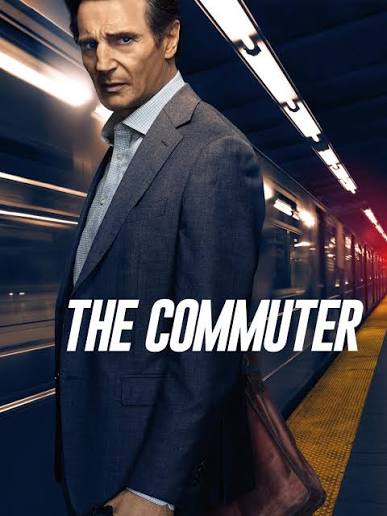
That’s excitement! That’s entertainment! Violence and aggression.
The equivalent for women might be found in Romancing the Stone. The romance novel writer finds herself caught up in a “real life” adventure story. Very Walter Mitty.
All of this adventure fantasy versus mundane reality is psychologically a subset of the anthropological concept of schismogenesis. Different adjacent groups reject the customs and practices of the other. Think braids versus mohawks.
But schismogenesis itself would seem accruately to be a subset of dialectical or dialogical thinking and emotional reaction. It also happens between siblings and intergenerationally, a means of asserting personal identity through differentiation.
Our myths and fantasies seem to be an adolescent rebellion against the predictable norms of our lives. Whether the norm is chaos or control, the imagination takes the form of its opposite.
In times where life noticeably lacked order such as the so-called Middle Ages, the imagination of Europeans at that time created highly bureaucratic orders of Heaven. There were no such clearcut hierarchies, not until the chaos of religious wars a few generations later, caused the hierarchies to solidify going into the Age of Enlightenment.
In modern industrial times, we have created a different idea of the Middle Ages in fantasy worlds like Tolkien’s Middle Earth to name just one of a nearly endless genre of the Dungeons & Dragons chaotic framing of life.
We look at the world of knights and ladies as also having magic and a great deal of social mobility based on individualistic effort.
It would seem in both cases, the actual Middle Ages of the Schoolmen and the modern industrial world of Mittys and clock-watchers, humans caught up in something escape into imaginary possibilities which offer the hyperbolized alternative as a relief from actual events.
In these two films we see something of this going on playing to the audience’s desire for the exotic opposite of a typical day, but in both cases, ironically, the characters do not want this alternative. They would prefer to have their predictable lives.
MacCauley’s commuter is an ex-cop. At sixty, he is now selling life insurance. He and his wife lost their nest egg in the 2008 crash of the housing market but they are still together going strong. With a son about to start college, they have taken out a second mortgage.
We get just enough of this man’s usual routine including the commute and relationships with others there and at work to set the Mitty baseline. But we also see his former cop self as a setup to make plausible this sixty-year-old insurance seller may have some potential when push comes to shove.
With William Foster the setup is much quicker. The guy has “anger issues” to say the least. Michael Douglas was born to play this kind of role. It is almost impossible for him not to seem angry in a character.
Even if you go back to Alias Smith and Jones and The Streets of San Francisco, or his cameraman in The China Syndrome, you can see it is more than just acting ability. Impersonations of his dad always used to characterize him as angry to good comic effect.
Both films use hot temperatures and broken air conditioning to set the stage and mood.
Events turn for MacCauley as we see him get fired, apparently without cause. With D-FENS, we find out only later in the action he lost his job “over a month ago” but he has continued to get up and pretend to go to work. He does not tell his mom or anyone.
Similarly, MacCauley does not tell his wife on the phone he no longer has a job. He does confide in his cop friend.
The more important difference between the two movies in this aspect has to do with agency and the secret to how the universe apparently works in each fictional reality.
In D-FENS’s world, he is “economically not viable” because of economic and social changes and stuff like that, the end of the Cold War, you know, big cliched explanations even idiots can nod about without too much reflection.
MacCauley’s predicament on the other hand has been curated by powerful people behind the scenes. Yes, spoiler alert! In this way it is closer to the Hitchcock tradition of North by Northwest or The Man Who Knew Too Much.
No one really did anything to Bill Foster. He “did everything he was told” throughout his life but the social contract he thought he signed on for was reneged. He’s a short-sleeved white shirt tie-wearing white guy who thought he was keeping the free world safe for family.
MacCauley as an ex-cop and even as an insurance salesman has perhaps a similar mythic role but his feeling of loss has almost no sense of entitlement, while Douglas’s Foster seethes with it.
Both characters ultimately resort to violence. MacCauley’s justification is far clearer. His family is being overtly threatened. His wife and son will be killed if he fails.
D-FENS is just angry at the world, at life. Ironically, his character seems more like actual persons in the subsequent years and now.
Like any mass murderer his behavior fits right in with anyone who “goes postal” in response to the soulless bureaucratic oppression from commuting to accepting getting clipped from your job, restrained by court order from coming near your wife and kid, etc.
But there is another more interesting contrast between the fictional worlds portrayed.
In Falling Down, there is a complexity of characters whose stories matter for the outcome and meaning. The world is not about D-FENS alone. The narrative and plot hinge on other characters’ stories.
The Commuter focuses narrowly on the main character. Every other character is pretty much there only to provide a backdrop and meaning for his story.
The elements of individuality and story for the other characters are so much fluff. No one cares or is expected to care for their problems. True, there are little touches to make it seem like “all lives matter.”
When the fake credit card girl throws them away, suggesting a break from her loser boyfriend, and when the nurse having relationship problems seems to hook up with the conductor at the end, this is so much window dressing.
It’s a true oddity of a sincere narcissism in the current norms of our fiction. Like we are pretending we care about innocent “collateral damage” victims in our non-war wars, while our lives go on. And we are surprised by the anger, let alone the violence of the victimized groups.
In The Commuter, even the unknown passenger our main man is searching for is only a device. The reveal of her tender, vulnerable status is a manipulation, like having the villain kick the dog for no reason to make us hate him more.
The difference in verisimilitude gets no small boost from the fact the cast of Falling Down is also higher caliber actors across the board.
From Robert Duvall’s Prendergast, a cop on his last day before retiring, to Foster’s ex-wife (Barbara Hershey) and his mom (Lois Smith), the contrast to The Commuter’s cardboard cutout characterizations and less well-known actors is clear.
The Commuter characters are drawn with enough detail and given enough time for the character arcs to stand on their own. They have moral and sympathetic weight in the fictional world. The Commuter character arcs seem like hastily applied stamps at the end of the ride.
These differences in the movies reflect differences in our attitudes about our relationships and how we have come to see the real world. Ultimately these are real differences in how we value ourselves and others.
The Commuter gives us a more narcissistic world. That fictional world is more like the D-FENS character. Falling Down with its multiple centers of sympathy is richer, and.more diverse in sympathy
Retiring cop Prendergast, his wife (Tuesday Weld), and their dead daughter are no less interesting and important than D-FENS, his ex-wife and their living daughter.
Prendergast and Foster are foils for one another in the story and in the fictional reality.
Whether we buy in or not, these differences between the realities of two films are as real as changes in laws and expectations over the twenty-five years.
The shift from Westerns to cop-themed TV and film in the later twentieth century, or from real sci-fi to superhero movies at the same time, show similar cultural shifts in attitudes and values.
I could go on and get into the weeds about how violence as the expression of male effectiveness and virility shows up in both movies. But I’d like to finish by focusing on the difference in resolutions in these films.
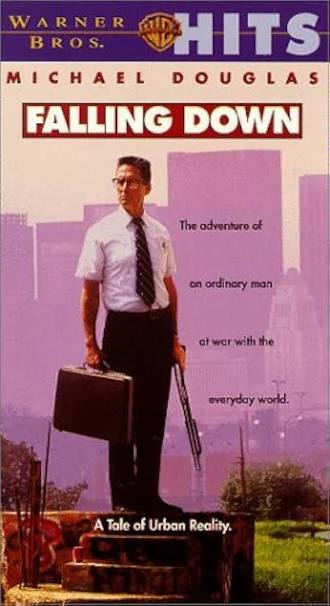
Falling Down ends will D-FENS going out cowboy style out-drawing Prendergast on the pier with his daughter’s squirt gun and getting shot, falling off the pier into the water. But not without having the last word.
Prendergast, by the way, turned in his gun earlier, and so he has use another female officer’s piece. He gets his manhood back! This is a theme, gag me, throughout the film, always punctuated by the same aggressiveness or open violence we are supposed to simultaneously condemn in D-FENS. Or are we? Hmm. Maybe not.
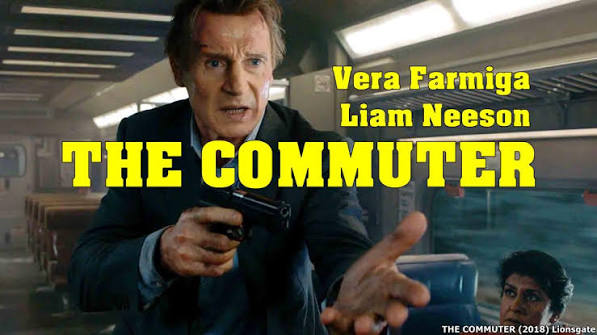
The Commuter ends with MacCauley returning to his manly profession of police officer and apprehending one of the main perps (Vera Farmiga) on a commuter train in Chicago. His redemption takes the form of going back to a career of kicking ass and solving crimes.
Undoubtedly I’ll return to this comparison. The details of Falling Down are not entirely silly. A Korean grocer, a racist, homophobic military surplus store owner, the portrayal of Los Angeles overall as a kind of urban hellscape full of ethnic tensions and bureaucratic indifference to human life.
The Commuter’s reality is less interesting. There it is the fantasy of conspiracies which can reach into our lives and get us to behave savagely which seems to be telling. Different ethnicities and social classes and such Us/Them don’t seem to matter. Us/Them is more dynamic, less ossified than in Falling Down.
You got your Irish, your LatinX, GenZ, assholes great and small, and none of that is any more interesting than suits in a deck of playing cards.

