Human knowledge is shared. It is the result of generations of humans collaborating and competing, cooperating with and confounding each other, and of the condition of cohabitating.
Just being together creates meaning. Often our mere existence offers the greatest innovations and insights. What we do with each other, ordinary behavior, also defines and determines who we are in our relationships and alone.
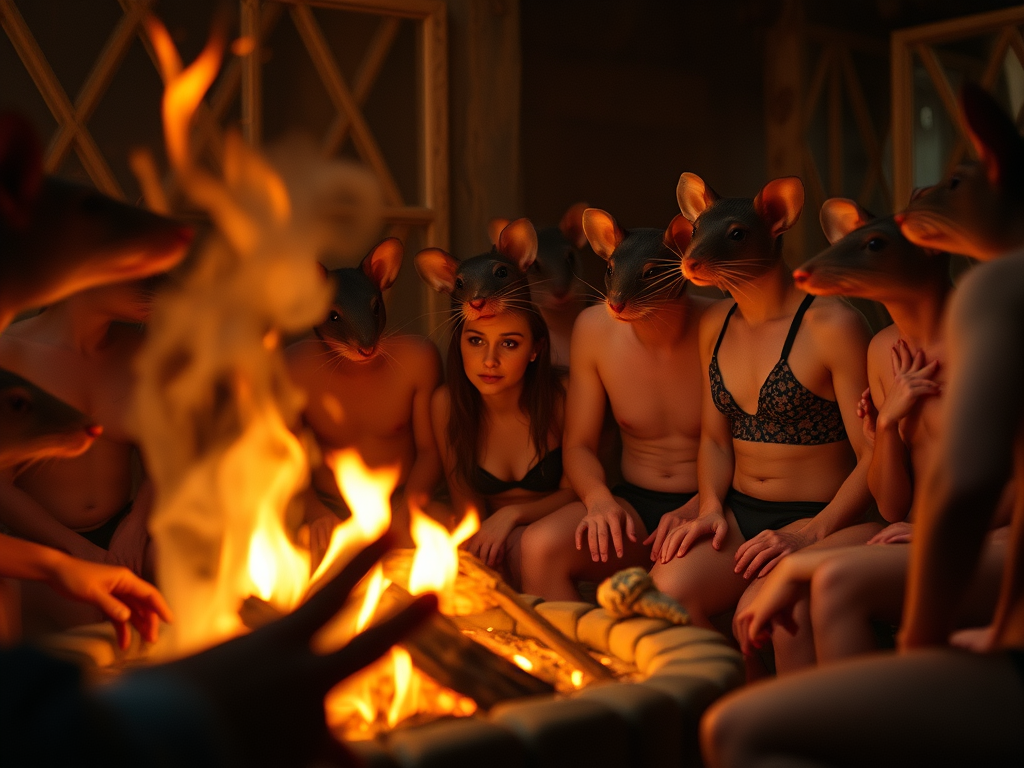
What is really going on around the campfire of our collective experience? Some of it is in the conversation, verbal and nonverbal, both what we make of it and what natural selection continues to shape.
What we make is riddled with errors because of a preference for stories and coherent causation, a preference which is a result of evolution.
The fundamentals of active inference and of our responses, a tendency for risk avoidance and our chemical motivation away from stress and excessive energy expenditure, lead us to confirmation bias, narrative fallacy, hindsight bias, etc.
We are primed to make sense of available information – just the facts we know – and to discount or ignore the unknowns. We prefer what comes easily to mind and can be easily recalled in stories or causal sequences.
We are bad at statistical thinking and reject luck or coincidence in favor of anecdotes with tidy narratives of this resulted from that, and something or someone is responsible, to blame or to praise.
The evolved mechanisms for efficiency lead us away from objective reality. Our tendencies to avoid error in most immediate situations cause great error in many cases and in the long run leave us vulnerable to extreme events which seem rare from experience.
E. M. Forster, or so I’ve read, gave an example prior to the experiments, decades later, showing some of these things. Consider the difference between these two descriptions of events.
1. The king died and then the queen died.
2. The king died, and then the queen died of grief.
Adding a comma and two words creates a story, a reason. Our desire for causation and narrative coherence, the result of natural selection, can also run counter to successful interpretation of what is actually going on.
Natural selection does not work for ideal or optimized outcomes, at least not by human standards. What is really going on eludes us. As we follow our own dopaminergic and other drivers, we lose track of the tangles of those tendencies as we move to pursue fact and truth.
There seems to be something waiting just beyond the light of the fire of what we know and how we know it. We know it is there, sensing it as we share what we know in the ways we have in common. Sometimes we catch a glimpse of it peripherally, that something else beyond.
What is it we are actually making with each other? Is it things, including institutions and ideas, or is it something else? Is it ridiculous to suggest we are creating kinds of human beings through our behavior together?
Are we not actually as humans in all we do together and alone making ourselves?
 I Dwell In Possibility