
Let’s say we are people who feel threatened by difference. For whatever reasons over the course of our lives we have come to feel that a difference of opinion is an assault on who we are.
We can flesh out the profile of such persons, that they were raised in an authoritarian household and were made to feel ashamed for being curious about matters and for asking questions.
Asking questions in many contexts was wrong, or so we learned, and being wrong is very shameful. Making mistakes is shameful. People who make mistakes and admit it are losers and guilty.
Being on the right side of things with the right beliefs and principles is very important. Not understanding anything is a sign of weakness.
We may not know everything but what we know and believe are the important things. Things we do not understand are not important or completely irrelevant.
We feel threatened by new information outside what we have learned and believe, especially if it contradicts our core understanding of right and wrong, and how matters ought to be.
Anyone who differs from us is threatening us. Philosopher John Locke whose writings and thought were very important to the so-called Founding Fathers fell into this reasoning trap.
In his Letter Concerning Toleration (1689), on page 36 of a document 45 pages long, he remarks that anyone not believing in God is not to be tolerated. What is his reasoning?
He asserts that only those who believe in some deity or other can be trusted. No oath or promise would bind the nonbelievers.
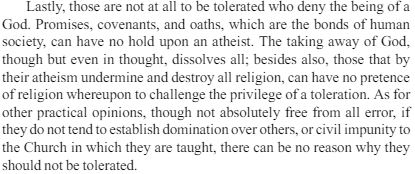
Well, John, bless your heart, but if you only knew what you didn’t understand about human behavior, you would probably die from shame.

A more recent example of a similar fallacy concerns same-sex marriage. The LBGTQ aka gay community is by no means in lockstep on this subject.
However, for a long time many heterosexuals believed if say gay men came out, they would suddenly be unmoored from their previous behavior patterns in every respect.
For my part, I was somewhat surprised, decades ago at a New Year’s Eve party, conversing with lesbian and gay couples about their gender roles in their relationships, and their ordinary American middle class values.
My thinking at the time was adjacent to the stupidity of those who believe the minute someone is out, he or she or they will run amok.
For longer in my own thinking than ought to have been for someone with many and strong personal connections in the community, I was of the opinion that the struggle for equal rights under the law and the freedom to live openly true to their authentic identity was tantamount to a demand we all gather in a circle and be forced to celebrate them, which, in retrospect, does not seem like such a bad idea.
I remember attending at least one same-sex wedding that was exactly that, as all weddings and other celebrations are and have been since prehistoric times, no doubt.
Getting back to us as intolerant folk, if we are people who feel difference is an affront to something we believe in and an attack on our identity, our response to considering differences like that is the same as eating something rancid.
Gustatory and moral disgust happen in the same parts of the brain. Habitual responses strengthen the connections in some areas and diminish other connections and also change the size of whole brain regions.
In the case of intolerant authoritarian folks, difference triggers the amygdala. The amygdala grows more sensitive to those triggers, and the amygdala itself can enlarge. The ability of the frontal cortex to regulate responses also diminishes in those social contexts.
These reactions and consequent behaviors become who we authentically are. The rational parts of our brain don’t stand a chance against the strong synaptic connections and the enhanced receptors, transmission enzymes and proteins, hormones, and dopaminergic cascades.
Add to that our go-to in terms of the three forms of social power (Graeber & Wengrow, The Dawn of Everything) more than likely runs thus: We use our charisma (such as it may be) to deride those who differ from us; then we claim to have superior insight (aka esoteric knowledge, e.g., from God) about them and the reality of the world and the threat they pose; and finally, coercive force becomes necessary to save ourselves, family, “the children,” culture, civilization, what have you.
The good news about this is that it is subject to change. We do not have to be this way. The first step is understanding the patterns and history, personal and cultural, which have led to this state of being.

 I Dwell In Possibility