A few days ago, an excerpt from Hemingways’ short story, “Fathers and Sons” reminded me of something that happened in a college class. It was a course focused on Hemingway at the College of Creative Studies (CCS), one of the colleges at UC Santa Barbara, taught by Alan Stephens.
Before sharing this anecdote, I had to reread the story, not having looked at it for many years. I remembered the father’s eyesight and the sheep but did not recall Dorothy or the flag. I remembered that smoking blunted a man’s sense of smell, but had forgotten about his father’s underwear. I remembered the little boy wanting to visit his grandfather’s tomb, but had forgotten the undertaker.
In short, many of the humorous bits as well as the way the story moves in time and mental focus, how the present brings back the past and the past comes into the present, did not come vividly to mind. I had forgotten these miracles of the writing, making me wonder now whether I had ever noticed them in the first place.
Mr. Stephens – he didn’t like to be addressed as “doctor” because he said he was not a medical man – had a special affinity for Hemingway. He had grown up in Colorado on a farm, to the best of my knowledge, at a time before WWII. He was about the same age as my father but from a very different background.
I had read some Hemingway in high school and had been astounded by how much I liked “The Sun Also Rises” and the short stories. This course in college gave me a chance to read everything. That’s the way CCS worked. We got grad student privileges at the libraries. You immersed yourself in whatever subjects you were studying.
On the day in class we were discussing “Fathers and Sons,” I was very excited because I had enjoyed the story. I had also come up with what I believed was a clever observation, if not necessarily the gospel of what the story might *secretly* be about.
You see, I was still unsure about what techniques of reading a piece of writing was asking for. For example, some stories are allegories and that kind of writing is not necessarily accurate about details of how things happen in actual life.
We can see the differences in the writing, and that tells us how we ought to be interpreting and reading. It has somewhat to do with authorial intention but it is also sometimes elements that are just there because that’s how the writer expresses matters without deliberating about them.
Hemingway, on the other hand, is a very deliberate artist. His detailed descriptions as in “Fathers” show intimate knowledge of what he’s describing. When he specifies plants, animals, the precise look of the landscape, these are not boxes he has checked, as perhaps I would writing about matters I only know broadly, indirectly.
That is the way a lot of professional writing in entertainment is. Professional writers in Hollywood do research, but it is never the same as authentically having done something you are writing about.
Even actors, who get intensive training and may be good at, say, horseback riding eventually, have a different focus; they are doing it to be able to look good on camera, which is different from if someone has lived something.
The depth of feelings alone comes out in “Fathers and Sons” in a way I could never duplicate if I were to write about hunting. I would throw out details to create a kind of set and matte painting as background for some other generic human interaction playing out in the foreground, and my words would be more about the sound and rhythm than careful descriptions.
In class that day, when I got a chance I laid out my theory. That this was a story about three generations. Nick’s dad had been gifted with preternatural eyesight, had been a good hunter, but unsound about sex. He had taught his son to love hunting. Nick, on the other hand, understood sex, but was not so good with death, which shows in his uneasiness about his father’s death. Nick’s son was better with death.
I won’t belabor the details. What I’ve described already should be enough to see what set my prof off. The reason for the extreme reaction, however, is more than just the fact I was applying the wrong reading and interpreting techniques to the story.
If we care deeply about something and understand it intimately it becomes part of us. When someone comes along, even if that person is young and learning, and violates our intimacy, we tend to overreact. Our identity is being challenged.
I was not mature enough at the time to understand these matters. Mr. Stephens was; he demonstrated this at other times, talking about Robert Frost’s out-thinking his own psychology. He also at other times would call on me directly because he knew I knew other things intimately and could provide insight.
“Fathers and Sons” does not ask for us to read it as a psychological comparison of generations. Those elements are if anything more like passing details. Parallels in the author’s actual life do not really matter for the story, except that without those experiences the story would lack dimensions and intimate authenticity.
My father passed away this past May. Mr. Stephens and other professors I studied under died long before. None of them are really at last anything close to my father in my personal life, but about Hemingway and hunting, Alan Stephens had a greater affinity. I will never have his feelings about hunting and farming.
The lives of previous generations in many ways stand apart from our lives. My mother’s father grew up on a farm in Alabama, raised by his Aunt Mary. I learned about gardening from him but it was of course very different from having lived on a farm.
It takes a bit of imaginative effort to get the picture of what life looked like to others not that long ago. Maybe it helps to have keen eyesight and heightened sensitivity.
No matter how special and unusual we believe we are, what skills or talent we may believe we genuinely possess, we are only as interesting to others as they find us to be at any time. Ultimately, if we are even lucky enough to keep our wits as we age, we still become less interesting as we lose interest in others and in ourselves.
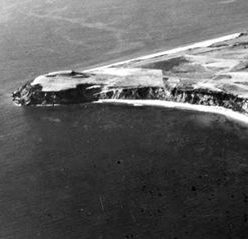
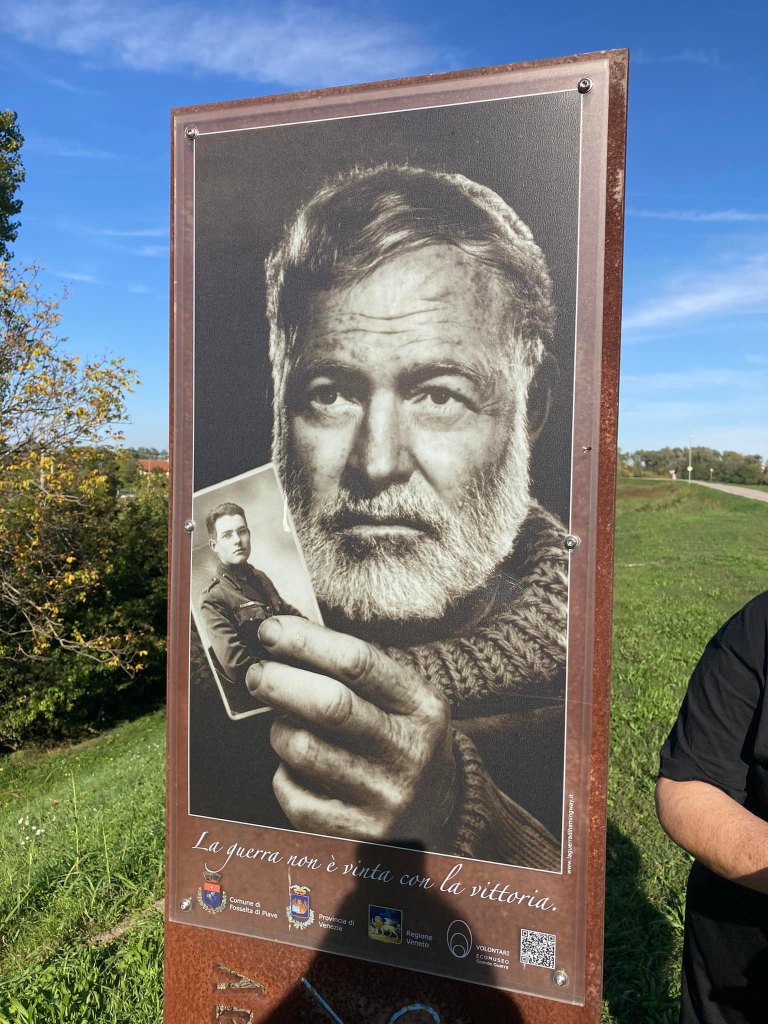
Thanks for allowing me to share this. I hope it will not incite negative reactions or challenge anyone’s identity in a transgressive way! I borrowed this photo from another post here. I think it fits with the concept of Hemingway’s story.
 I Dwell In Possibility